Philip Marlowe
The Big SleepPhilip Marlowe is the private detective and first-person narrator of The Big Sleep. His defining significance lies in the tension between his professional independence and his obligation to a wealthy client: he follows clues toward the truth, but withholds and filters information, helping determine which version of events becomes public. His investigation begins with a missing-person question entangled in blackmail and murder, and ends with a private revelation about Rusty Regan that does not become an official resolution.
Identity and Introduction
Marlowe presents himself at the Sternwood estate in a powder-blue suit, neat, sober, and conscious of the professional image he projects. His description of himself as the well-dressed detective calling on four million dollars captures both his polish and the economic power of his client. The grandeur of the house, with its stained-glass knight unable to free a naked lady tied to a tree, gives his arrival an emblematic setting: Marlowe notices an apparent rescue that is not being carried through, an image that echoes the difficult business of intervening in the Sternwood family’s troubles.
He identifies himself as thirty-three, unmarried, and able to speak English despite saying that his trade rarely calls for it. He once worked as an investigator for the District Attorney, under Wilde, until he was fired for insubordination. His account is brisk and self-deprecating, but the fact of that dismissal establishes an important boundary: he has experience inside official law enforcement, yet does not remain obedient to its hierarchy. Bernie Ohls, Wilde’s chief investigator, is the channel through which Marlowe learns that General Guy Sternwood wants to see him.
The name Marlowe gives Carmen Sternwood when they first meet is the false identity Doghouse Reilly. He later learns that Carmen has discovered his real name and occupation from the card Vivian Regan showed her. The contrast is characteristic of his method: Marlowe can perform a temporary role, but the disguise does not hold, and Carmen’s knowledge changes the terms of their interaction.
Investigation and Plot Trajectory
The investigation develops from Geiger’s blackmail operation into a chain of deaths, hidden evidence, and disputed explanations. At Geiger’s house, Marlowe hears a scream, then gunshots and the sound of someone leaving. When he returns later, Geiger’s body has disappeared; the room has been rearranged, and parallel grooves in the rug suggest that the body was dragged toward the front door. He finds that the physical scene has been altered, but the evidence does not yet provide an official account of what happened.
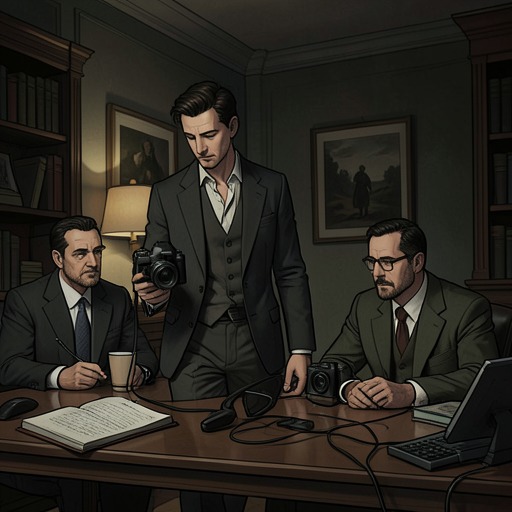
Marlowe’s reconstruction of Geiger’s death comes into focus through Joe Brody’s account. Brody admits following Owen Taylor after the shooting, knocking him down, and taking the plate holder from him; after developing the plate, Brody recognized Carmen in the photograph and saw an opportunity to take over Geiger’s book operation and extort the Sternwoods. Marlowe argues that Taylor, who loved Carmen, had the motive and opportunity to shoot Geiger after catching him photographing her. Brody’s reported conduct helps explain how the photograph passed into his hands, while Marlowe’s distinction between what is physically possible and what is morally credible shows that his solution rests on assessing character as well as circumstance.
The Buick’s plunge at Lido Pier brings the police into the investigation. Bernie Ohls reasons from the broken pier boards, their dryness inside after the rain, the tide, and the car’s discovery beneath the water to place the crash at roughly nine-thirty or ten the previous night. The physical circumstances support a time and manner of death, but they do not by themselves establish why Taylor drove through the barrier. Marlowe’s casework repeatedly occupies that space between observable traces and a fuller account of motive.
The Regan disappearance remains a separate, older mystery beneath the immediate Geiger and Brody cases. Captain Gregory tells Marlowe that Regan left on September 16, when the chauffeur was off duty; no one saw him take his car. Four days later the car was found in a garage at Casa de Oro, but investigators could not identify who had put it there, and no fingerprints matched their records. Gregory also explains that Eddie Mars’s wife was living at the same place and had left around the time Regan did, strengthening the appearance that she and Regan might have gone away together without proving that explanation.
Marlowe’s own deductions depend in part on information the police do not have. He explains to General Guy Sternwood that Vivian Regan let slip that the police had found Regan’s car; he inferred that the Missing Persons Bureau must have the case and that the police would know more because the chauffeur had a record. He also reads Wilde’s manner during a meeting about Geiger as evidence that the District Attorney understood General Sternwood to have engaged him to find Regan. Marlowe describes this as a chain of inference, not direct knowledge, and acknowledges that he tried to approach Captain Gregory without telling him anything he did not already know.
Method, Judgment, and Professional Ethics
Marlowe’s reasoning is practical and interpretive rather than confined to a single decisive clue. In assessing Brody, he considers the possibility that Brody killed Geiger, stole the photograph, framed Taylor, and arranged Taylor’s death, but rejects that theory as requiring too many coincidences and conflicting with Brody’s apparent intentions and character. He accepts jealousy and the photograph as a more persuasive motive for Taylor, who was in one of the Sternwood family’s cars without permission. His conclusion is reasoned from the evidence available to him, though the narrative also makes plain the difference between a detective’s persuasive reconstruction and a demonstrable public finding.
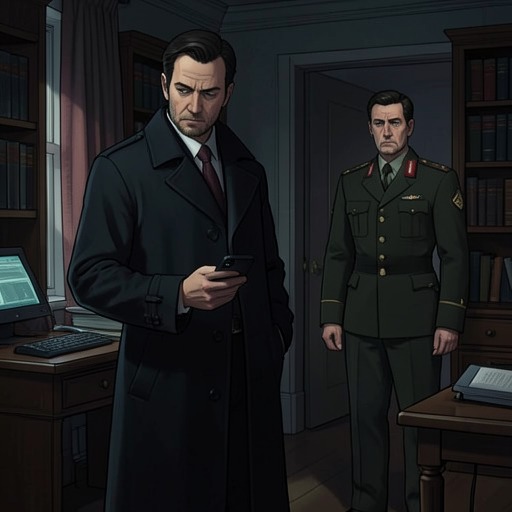
That distinction becomes ethically costly when Marlowe reports the case to Captain Cronjager, Wilde, and Ohls. He tells them what happened but deliberately leaves out two things: Carmen’s visit to Brody’s apartment and Eddie Mars’s visit to Geiger’s house that afternoon. Cronjager accuses him of failing to report a murder and then spending the day in ways that helped lead to another killing. Marlowe concedes that he wanted to protect his client and had not expected the young man to go after Brody. Cronjager’s criticism identifies the consequence of that choice: withholding information in the name of a client can shape the course of events, not merely the later account of them.
Marlowe defends his judgment of Brody against Wilde’s suggestion that the evidence might have been planted. He says that a staged alternative is physically possible but, in his view, morally implausible, because it requires Brody to have committed a complicated sequence of acts inconsistent with what Marlowe observed. The defense makes his professional ethic neither simple obedience to the police nor a claim to certainty. He weighs motive, opportunity, character, and physical traces, while accepting that his choices can leave him implicated in concealment.
He later states the cost plainly: he has concealed a murder and suppressed evidence for twenty-four hours, yet remains at large and expects a five-hundred-dollar check. The juxtaposition is deliberately uncomfortable. He recognizes that the prudent response would be to take a drink and forget the affair, but instead calls Eddie Mars and goes to speak with him. His work continues not because his conduct has been cleared, but because his curiosity and sense of the unfinished case outweigh that safer course.
Public Narrative and Private Truth
The morning papers publish an account that turns the tangled events into a neat official story. They do not connect Owen Taylor, described as the driver of the Lido Pier suicide car, with the killing at Geiger’s bungalow; they omit the Sternwoods, Ohls, and Marlowe. Instead, they credit Captain Cronjager with solving two murders arising from a dispute over a wire-service racket: Brody supposedly killed Geiger, and Carol Lundgren killed Brody in revenge. Lundgren is held in custody and has confessed; Agnes Lozelle is held as a material witness. The papers also report Taylor’s death as a suicide and say there will be no inquest.
Marlowe judges this public account to be far from the truth. Its details are not merely incomplete: it assigns the killings to different people and compresses their timing into a convenient sequence, while giving the police credit for an uncomplicated solution. The contrast between his private reconstruction and the newspaper version establishes one of the novel’s central problems: a coherent official narrative can be produced without accurately explaining the events that generated it.
The newspapers’ treatment also clarifies the limits of what Marlowe can accomplish. He can recover connections between evidence and motive, but he does not simply hand a complete, impartial case to the authorities. His own omissions help keep the Sternwood scandal out of the account, and the official version in turn conceals the family’s connection to the deaths. Truth in this investigation is therefore divided among physical evidence, private knowledge, police inference, and a publishable story that excludes inconvenient facts.
Regan, the Ending, and Narrative Role
At the end, Marlowe tells Vivian that Carmen killed Regan. His reconstruction places the murder late in the afternoon on the day Regan disappeared, when Regan took Carmen to old oil wells to teach her to shoot. He had put up a can for her to aim at; Marlowe says she turned the gun toward Regan and shot him instead, as she later tried to shoot Marlowe for the same reason. Vivian’s reaction conveys the force of the revelation, but Marlowe offers it to her as a conclusion reached through his investigation, not as a public confession or a verdict delivered in court.
The disclosure forces a distinction between two disappearances that had seemed connected. The evidence about the car at Casa de Oro and Eddie Mars’s wife had encouraged suspicion that Regan had gone away with her; Marlowe’s final account instead identifies Carmen’s act as the cause of Regan’s disappearance. Yet the truth remains contained within a private conversation. The account that could settle the mystery for the reader does not become the account that the authorities or newspapers publish.
Marlowe’s closing meditation on death gives the case its bleakest measure. He considers the difference between lying in a dirty sump and in a marble tower, then concludes that death makes those distinctions immaterial: the dead are sleeping the big sleep. He includes himself among those implicated in the nastiness surrounding Regan’s death, while imagining General Guy Sternwood still quiet in his canopied bed, his health failing and his future likewise measured by death. The final image does not resolve Marlowe’s ethical conflict. It leaves him with knowledge, complicity, and a truth withheld from public judgment—the cost of a private code operating inside a corrupt and incomplete system.